Why Is Business Communication Important?
Effective business communication helps an organization run smoothly by ensuring that the right information reaches the right people at the right time. From sharing instructions and making decisions to managing teams and communicating with customers, clear communication plays an important role in achieving business goals.
Here are some key reasons why business communication is important:
1. Improves Coordination
Clear communication helps employees and teams understand their roles, responsibilities, deadlines, and priorities. For example, a project team can stay aligned through regular meetings, emails, or updates.
2. Supports Better Decision-Making
Managers and employees need accurate information to make informed decisions. Effective business communication ensures that important updates, data, feedback, and ideas are shared clearly before decisions are made.
3. Builds Stronger Workplace Relationships
Open and respectful communication helps build trust between employees, managers, and teams. It also makes collaboration easier and encourages people to share their ideas and concerns.
4. Increases Productivity
When instructions and expectations are clear, employees can spend less time dealing with confusion and more time completing their work. This can improve efficiency and help teams work toward shared goals.
5. Reduces Misunderstandings and Errors
Unclear messages can lead to mistakes, missed deadlines, and unnecessary confusion. Good communication helps ensure that everyone understands what needs to be done and when.
6. Strengthens Customer Relationships
Business communication is also important when interacting with customers. Clear, timely, and professional responses can help address queries, resolve concerns, and create a better customer experience.
7. Supports Leadership and Employee Engagement
Leaders rely on communication to share goals, provide direction, give feedback, and motivate their teams. Employees are also more likely to stay engaged when they understand organizational expectations and feel comfortable sharing their views.
8. Helps Build Brand and Business Reputation
Every interaction with customers, clients, partners, and the public can influence how a business is perceived. Consistent and professional communication helps organizations build trust and maintain a positive reputation.
In simple terms we can say, Effective Communication → Better Understanding → Better Coordination → Improved Decisions → Stronger Business Performance |
What Are the Objectives of Business Communication?
The objectives of business communication focus on sharing information clearly, guiding employees, supporting decisions, and helping organizations achieve their goals.
To Share Information
- Shares important updates, facts, policies, and business-related information.
- Example: Communicating a new company policy to employees.
To Provide Instructions and Direction
- Helps employees understand their tasks, responsibilities, and expected outcomes.
- Example: A manager sharing work instructions with a team
To Support Decision-Making
- Provides information, insights, and feedback needed to make informed decisions.
- Example: Reviewing project data before selecting a business strategy.
To Persuade and Influence
- Encourages people to consider an idea, product, service, or specific course of action.
- Example: Delivering a sales pitch to a potential customer.
To Build Relationships
- Helps build trust and maintain positive relationships with employees, customers, clients, and other stakeholders.
- Example: Regularly communicating with clients to understand their needs.
To Receive and Provide Feedback
- Creates opportunities to share opinions, suggestions, and performance-related feedback.
- Example: A manager discussing an employee's performance and areas for improvement.
To Coordinate Business Activities
- Keeps teams and departments aligned on tasks, timelines, responsibilities, and priorities.
- Example: Conducting a project meeting to coordinate upcoming activities.
To Achieve Organizational Goals
- Aligns communication, decisions, and actions with the organization's broader goals.
- Example: Leaders communicating company targets and expectations to employees.
Types of Business Communication
The different types of business communication can be classified based on the people involved, the direction of information flow, and the level of formality. These types help organizations choose the right way to communicate in different workplace situations.
Internal and External Communication
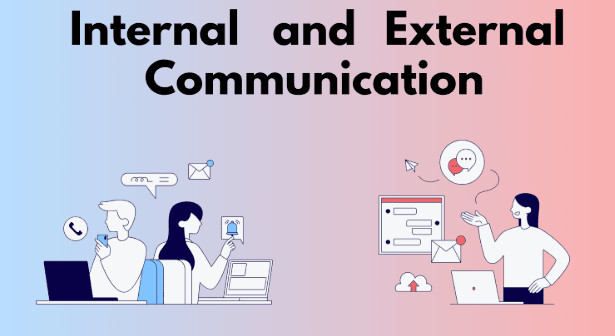
- Internal communication takes place within an organization, such as communication between employees, teams, and managers.
- External communication involves people outside the organization, including customers, clients, suppliers, and business partners.
- Example: A manager sharing a project update with employees is internal communication, while responding to a customer query is external communication.
Formal and Informal Communication
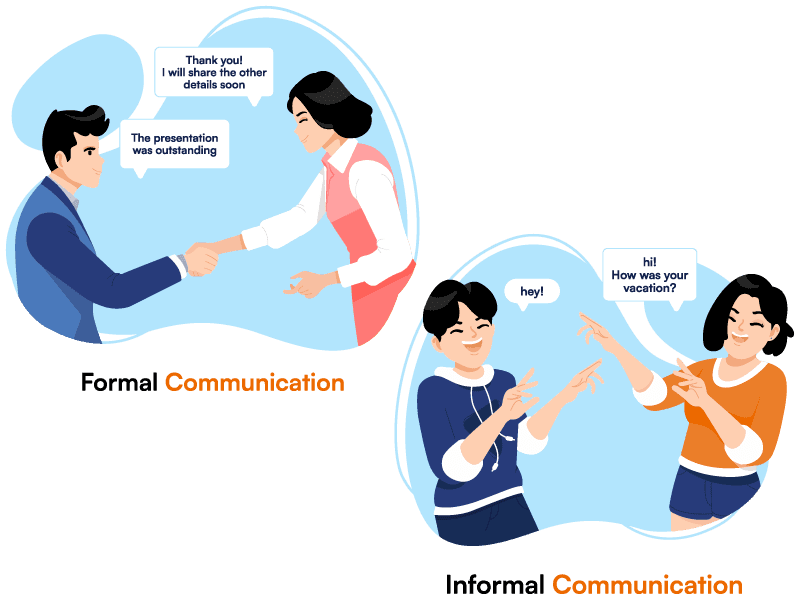
- Formal communication follows official channels and organizational structures. It may include official emails, reports, meetings, notices, and company announcements.
- Informal communication is more casual and often takes place through everyday conversations or workplace interactions.
- Example: A company policy sent through an official email is formal communication, while employees discussing work during a break is informal communication.
Upward Communication
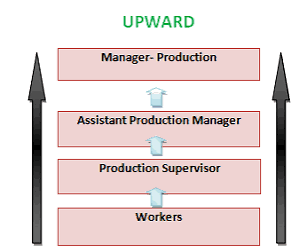
- Upward communication flows from employees to managers or senior leadership. It allows employees to share feedback, concerns, suggestions, and updates with people at higher organizational levels.
- Example: An employee sharing feedback about a workplace process with their manager is upward communication.
Downward Communication
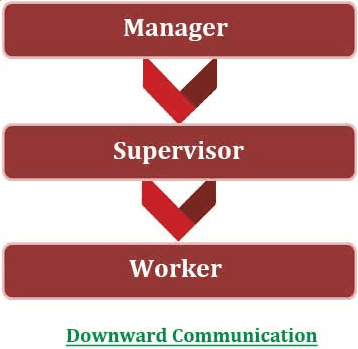
- Downward communication flows from managers or senior leaders to employees. It is commonly used to provide instructions, share policies, communicate goals, and give feedback.
- Example: A manager assigning tasks and explaining project deadlines to a team is downward communication.
Horizontal or Lateral Communication

- Horizontal communication, also known as lateral communication, takes place between employees, teams, or departments working at similar organizational levels. It helps improve coordination and collaboration.
- Example: The marketing and sales teams discussing a campaign launch is horizontal communication.
Diagonal Communication
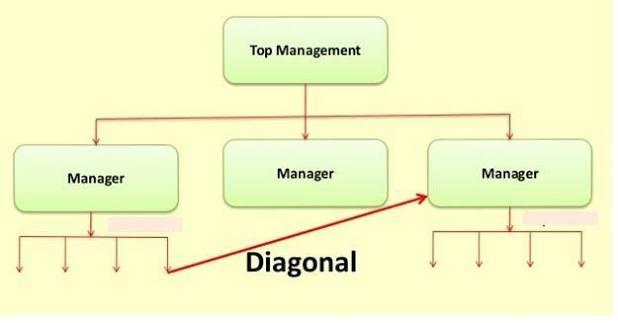
- Diagonal communication takes place between employees or managers from different departments and different organizational levels. It can help teams share information and coordinate work across functions.
- Example: A finance manager discussing a project budget directly with a junior employee from the operations team is diagonal communication.
Businesses use different forms and methods of business communication depending on the message, audience, and situation. Below are some methods of business communication.
Method | Best Used For | Example |
Verbal Communication | Quick discussions, immediate feedback, and direct interaction | Team meeting or phone call |
Written Communication | Formal communication and maintaining records | Email, report, proposal, notice, or business letter |
Non-Verbal Communication | Supporting and reinforcing spoken messages | Body language, eye contact, posture, or gestures |
Visual Communication | Simplifying complex information and presenting data | Charts, graphs, dashboards, slides, or infographics |
Digital Communication | Remote collaboration and online communication | Video meetings, workplace messaging, or digital documents |
Channels of Business Communication
Channels of business communication are the different mediums through which information is shared within and outside an organization.
Formal Communication Channels
Formal communication channels are official methods used to share structured and important information. These channels usually follow organizational rules and help maintain a proper record of communication.
Common examples include:
For example, a company may use an official email to communicate a policy update to all employees.
Informal Communication Channels
Informal communication channels are used for casual and everyday workplace interactions. They can help employees quickly exchange ideas, clarify information, and build professional relationships.
Common examples include:
For example, two colleagues discussing a task during a break may be using an informal communication channel.
Digital Communication Channels
Digital channels use technology to support communication and collaboration, particularly in remote and hybrid workplaces.
Common examples include:
- Workplace messaging platforms
- Project management platforms
For example, a remote team may use video conferencing for meetings and a project management platform to share task updates.
Written Communication Channels
Written channels are useful when information needs to be documented, reviewed, or shared formally with others.
Common examples include:
For example, a business may send a written proposal to a client outlining the scope and terms of a project.
Verbal Communication Channels
Verbal communication channels involve the use of spoken words and are useful when direct interaction, discussion, or immediate feedback is required.
Common examples include:
For example, a manager may use a face-to-face meeting to discuss a complex project with the team.
How to Choose the Right Communication Channel
The right business communication channel depends on the situation.
Before choosing a channel, consider:
- Urgency: Use a phone call or direct conversation when immediate attention is needed.
- Complexity: Use a meeting or presentation for detailed discussions.
- Documentation: Choose emails, reports, or other written channels when a record is required.
- Sensitivity: Consider a private conversation for confidential or sensitive topics.
- Audience: Think about the size and location of the people receiving the message.
- Feedback: Use verbal or interactive channels when immediate responses are important.
The table highlights which business communication channel works best for different situations, along with practical examples of when to use each one.
Channel | Best Used For | Example |
Email | Formal communication and documentation | Project update |
Meeting | Complex discussions and collaboration | Strategy discussion |
Phone Call | Urgent communication | Immediate clarification |
Video Call | Remote collaboration | Virtual team meeting |
Report | Sharing detailed information | Performance analysis |
How Does the Business Communication Process Work?
The business communication process is a step-by-step cycle through which information moves from one person to another. It starts with a sender creating a message and ends with the receiver understanding it and providing feedback. A clear communication process helps reduce confusion and ensures that information is understood as intended.
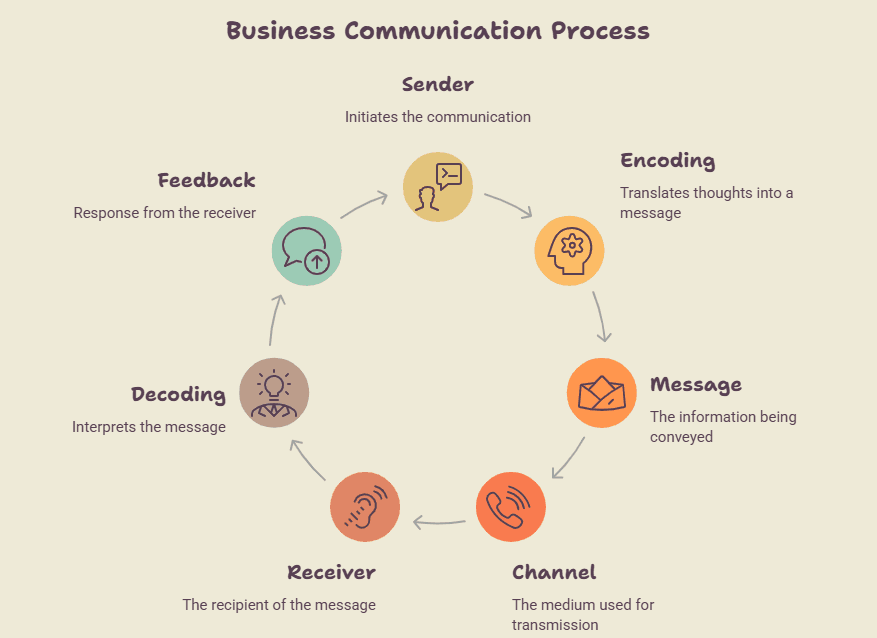
1. Sender
The sender is the person, team, or organization that starts the communication. They identify what needs to be communicated and decide what they want the receiver to understand or do.
Example: A manager wants to inform the team about a new project deadline.
2. Encoding
Encoding is the process of converting an idea or thought into words, symbols, visuals, or other forms that can be communicated.
Example: The manager turns the project update into a clear email with the new deadline.
3. Message
The message is the actual information, idea, instruction, or feedback that the sender wants to communicate.
Example: “The project deadline has been moved to August 25.”
4. Communication Channel
The communication channel is the medium used to deliver the message to the receiver. The choice depends on the urgency, complexity, audience, and purpose of the communication.
Examples: Email, phone call, meeting, video call, report, or workplace messaging platform.
5. Receiver
The receiver is the person or group for whom the message is intended.
Example: The employees working on the project receive the manager's update.
6. Decoding
Decoding is the process through which the receiver interprets and understands the message.
Example: Employees read the email and understand that they need to complete their tasks before the revised deadline.
7. Feedback
Feedback is the response the receiver provides to the sender. It helps confirm whether the message was understood correctly.
Example: An employee replies to the email confirming the new deadline or asks for clarification.
8. Noise or Barriers
Noise refers to anything that can interfere with the communication process or affect how a message is understood. It can occur at any stage of communication.
Examples: Poor internet connectivity, unclear language, distractions, cultural differences, incorrect assumptions, or information overload
Business Communication vs. Organizational Communication
Business communication and organizational communication are closely related, but they are not exactly the same. Business communication generally focuses on exchanging information to support business activities and goals, while organizational communication has a broader focus on how information, ideas, and relationships flow throughout an organization.
Basis | Business Communication | Organizational Communication |
Meaning | Communication used to support business activities, decisions, and goals | Communication that takes place across an organization and its different levels |
Scope | Focuses on business operations and interactions with stakeholders | Covers communication across organizational systems, teams, relationships, and culture |
Audience | Employees, customers, clients, suppliers, and business partners | Employees, managers, teams, leaders, and other organizational stakeholders |
Focus | Business objectives, productivity, and outcomes | Organizational culture, coordination, relationships, and communication flow |
Direction | Can occur internally and externally | Often focuses on communication within the organization |
Example | Sending a sales proposal to a potential client | Sharing information across departments to coordinate a project |
Business Communication vs. Marketing Communication
Business communication and marketing communication both help organizations achieve their goals, but they serve different purposes. Business communication covers a broad range of internal and external interactions, while marketing communication specifically focuses on promoting products, services, and brands to target audiences.
Basis | Business Communication | Marketing Communication |
Primary Purpose | Supports overall business operations and activities | Promotes and positions products, services, or brands |
Audience | Employees, customers, clients, suppliers, and other stakeholders | Primarily target customers, prospects, and market segments |
Scope | Broad and covers different business functions | More specialized and focused on marketing activities |
Main Objective | Supports information sharing, coordination, decision-making, and relationships | Builds awareness, engages customers, influences perceptions, and encourages action |
Communication Style | Can be formal, informative, instructional, or collaborative | Often persuasive, creative, promotional, and customer-focused |
Examples | Reports, meetings, emails, business proposals, and internal announcements | Advertising, social media campaigns, promotional emails, and product launches |
What Are the 7 Cs of Effective Business Communication?
The 7 Cs of effective business communication are practical principles that help make professional messages clear, useful, and easy to understand. Following these principles can reduce confusion, improve workplace interactions, and ensure that the intended message reaches the audience effectively.
Clear
A clear message is easy to understand and has a specific purpose. Avoid vague statements, unnecessary jargon, or language that could confuse the reader.
Example: Instead of saying, “Send it soon,” say, “Please send the report by 5 PM today.”
Concise
Concise communication delivers the required information without unnecessary words or repetition. Keep your message focused while including all important details.
Example: Use short, direct sentences in professional emails rather than adding irrelevant information.
Concrete
Concrete communication uses specific facts, details, and examples instead of vague statements. This makes the message easier to understand and act upon.
Example: “Sales increased by 15% in July” is more concrete than “Sales improved significantly.”
Correct
Correct communication should contain accurate information and appropriate grammar, spelling, punctuation, and facts. Errors can affect the credibility of a professional message.
Example: Check names, figures, dates, and grammar before sending an important business email.
Coherent
A coherent message follows a logical structure, with ideas connected in a way that is easy to follow. The information should flow naturally from one point to another.
Example: Present the purpose first, followed by relevant details and the expected action.
Complete
Complete communication provides all the information the recipient needs to understand the message or take the required action.
Example: When inviting someone to a meeting, include the date, time, location or meeting link, agenda, and any preparation required.
Courteous
Courteous communication is respectful, professional, and considerate of the recipient. Even when addressing disagreements or problems, the language should remain constructive.
Example: Instead of saying, “You made a mistake,” say, “Could we review this section and correct the issue?”
Key Tip: Before Sending a Business Message, Ask: - Is all the essential information included?
- Is the tone appropriate for the audience?
- Have I checked the facts, grammar, and spelling?
- Does the recipient understand what action is expected?
- Is the message concise and logically organized?
- Have I communicated the information in a respectful and professional way?
|
Further Read on 4cs of marketing essential in business
Essential Business Communication Skills
Strong business communication skills help professionals share ideas clearly, collaborate with teams, handle workplace situations, and build better professional relationships. These skills are useful for students, fresh graduates, managers, and working professionals across different industries.
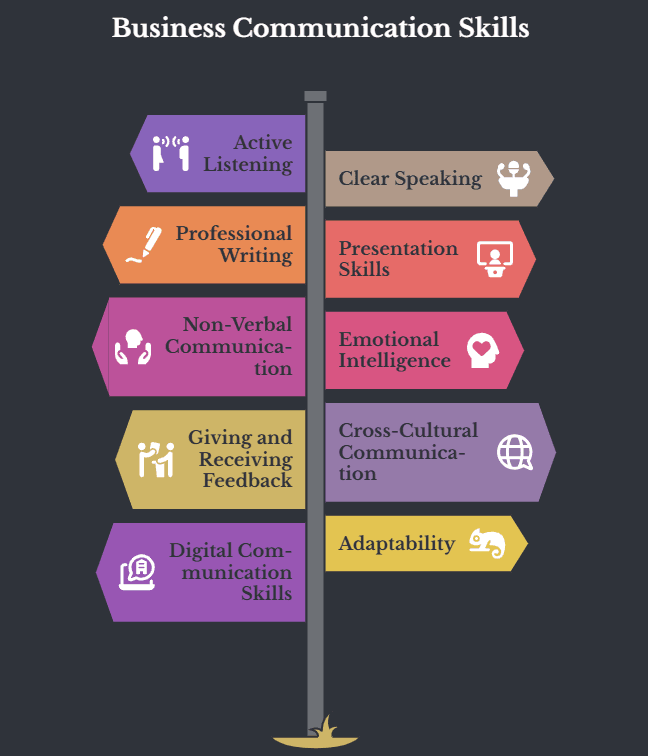
Skill | Why It Matters | How to Develop It |
Active Listening | Helps understand messages clearly and reduces misunderstandings | Ask clarifying questions and listen without interrupting |
Clear Speaking | Makes ideas, instructions, and opinions easier to understand | Practice speaking clearly in discussions and meetings |
Professional Writing | Helps communicate information clearly through emails, reports, and documents | Practice writing structured and concise emails |
Presentation Skills | Helps communicate ideas confidently to teams and stakeholders | Practice presentations and use clear visual aids |
Non-Verbal Communication | Supports spoken messages through body language and other cues | Pay attention to posture, eye contact, gestures, and facial expressions |
Emotional Intelligence | Helps manage emotions and respond appropriately to others | Consider different perspectives and audience reactions |
Giving and Receiving Feedback | Supports learning, performance, and professional growth | Give specific, constructive feedback and remain open to suggestions |
Cross-Cultural Communication | Helps professionals work effectively with people from different backgrounds | Learn about cultural differences and avoid assumptions |
Digital Communication Skills | Supports effective communication in remote and hybrid workplaces | Practice professional email, video meeting, and workplace chat etiquette |
Adaptability | Helps adjust communication based on the audience, purpose, and situation | Change your tone, language, and communication method when needed |
Etiquette of Business Communication
Following proper business communication etiquette helps professionals communicate clearly, respectfully, and appropriately in different workplace situations.
Use this checklist to review your communication habits:
- Be clear and concise: Keep your message focused and easy to understand.
- Maintain a professional tone: Communicate respectfully, even during disagreements.
- Check grammar and spelling: Proofread emails, reports, and other important messages.
- Respond on time: Acknowledge important messages and respond within a reasonable timeframe.
- Use appropriate language: Choose words that suit the audience, workplace, and situation.
- Use professional greetings and sign-offs: Start and close formal messages appropriately.
- Write clear email subject lines: Make the purpose of your email easy to identify.
- Respect privacy and confidentiality: Handle sensitive business and personal information responsibly.
- Practice active listening: Pay attention, avoid unnecessary interruptions, and ask questions when needed.
- Use professional formatting: Structure emails and documents so they are easy to read.
- Follow proper meeting etiquette: Be punctual, prepared, attentive, and respectful of others' time.
- Acknowledge important messages: Confirm receipt when a message requires action or follow-up.
- Adapt to the audience and context: Adjust your tone, language, and communication channel based on the situation.
What Are the Barriers to Effective Business Communication?
Even when organizations have good communication systems, several barriers to effective business communication can affect how a message is shared, understood, or acted upon. Let's learn about each barrier in detail,
Language Barriers
- Meaning: Differences in language, vocabulary, pronunciation, or technical terms can make messages difficult to understand.
- Impact: Can cause confusion, incorrect interpretation, and communication errors.
- Solution: Use simple language, explain unfamiliar terms, and confirm understanding.
Cultural Differences
- Meaning: People from different cultures may have different communication styles, expectations, and social norms.
- Impact: May lead to misunderstandings or unintended offense.
- Solution: Develop cultural awareness and respect different communication styles.
Lack of Clarity
- Meaning: Messages may be vague, incomplete, or unnecessarily complicated.
- Impact: Can create confusion, mistakes, and delays.
- Solution: Use clear, specific, and concise language.
Poor Listening
- Meaning: Failing to pay attention or understand what another person is saying.
- Impact: Important information may be missed or misunderstood.
- Solution: Practice active listening and ask clarifying questions.
Information Overload
- Meaning: Sharing too much information at once can make important details difficult to identify.
- Impact: Can reduce understanding and make decision-making harder.
- Solution: Prioritize key information and organize messages logically.
Emotional Barriers
- Meaning: Stress, frustration, fear, or anger can influence how people communicate.
- Impact: May lead to defensive responses, conflict, or misinterpretation.
- Solution: Manage emotions and maintain a calm, professional tone.
Wrong Communication Channel
- Meaning: Using a communication method that does not suit the message or situation.
- Impact: Can make communication less effective or delay important responses.
- Solution: Choose the channel based on urgency, complexity, sensitivity, and audience.
Physical and Technical Barriers
- Meaning: Poor internet connectivity, background noise, equipment issues, or unsuitable environments can disrupt communication.
- Impact: Messages may be interrupted, missed, or misunderstood.
- Solution: Use reliable technology and an appropriate communication environment.
Organizational Hierarchy
- Meaning: Employees may feel hesitant to communicate openly with managers or senior leaders.
- Impact: Important feedback, concerns, or ideas may not reach decision-makers.
- Solution: Encourage open communication and provide accessible feedback channels.
Stereotyping and Bias in Communication
- Meaning: Stereotyping in business communication can lead people to make assumptions about others based on characteristics rather than their individual behavior, abilities, or perspectives.
- Impact: It can reduce trust, create misunderstandings, cause exclusion, and affect teamwork.
- Solution: Avoid assumptions, encourage inclusive communication, and consider individual perspectives.
Business Communication vs General Communication
Business communication is mainly used in professional settings to support organizational goals, while general communication can take place in personal, social, academic, or everyday situations.
Basis | Business Communication | General Communication |
Purpose | Supports organizational goals, coordination, decisions, and business activities | May serve personal, social, academic, or everyday purposes |
Audience | Employees, managers, customers, clients, and other stakeholders | Friends, family, colleagues, acquaintances, or anyone |
Tone | Usually professional, clear, and purposeful | Varies depending on the relationship and situation |
Documentation | Often documented through emails, reports, proposals, or records | May or may not be documented |
Structure | Usually follows a specific purpose, format, or communication channel | Can be formal, informal, structured, or casual |
Outcome | Often aims to support decisions, actions, coordination, or business relationships | Depends on the context and purpose of the communication |
Example | Sending a project update to a manager | Discussing weekend plans with a friend |
Real-Life Examples of Business Communication
Business communication happens in everyday workplace situations, from sending a quick email to presenting an important proposal. The right communication method can help professionals share information clearly, solve problems, and achieve the desired outcome.
Sending a Professional Email
- Scenario: An employee needs to update their manager about the progress of a project.
- Communication method: Professional email with a clear subject line and concise details.
- Desired outcome: The manager understands the progress and any action required.
Giving Instructions to a Team
- Scenario: A manager needs to assign tasks and deadlines for an upcoming project.
- Communication method: Team meeting, written instructions, or workplace collaboration platform.
- Desired outcome: Every team member understands their responsibilities and deadlines.
Handling a Customer Complaint
- Scenario: A customer contacts a company about a delayed order or service issue.
- Communication method: Phone call, email, or customer support conversation.
- Desired outcome: The concern is addressed professionally and the customer receives a suitable resolution.
Presenting a Business Proposal
- Scenario: A company wants to present a new project or service idea to a potential client.
- Communication method: Business presentation supported by a proposal or visual materials.
- Desired outcome: The client understands the proposal and considers moving forward.
Giving Feedback to an Employee
- Scenario: A manager needs to discuss an employee's performance and suggest areas for improvement.
- Communication method: One-to-one meeting or performance review.
- Desired outcome: The employee understands the feedback and knows what steps can improve performance.
Conducting a Virtual Meeting
- Scenario: A remote team needs to discuss project updates and upcoming tasks.
- Communication method: Video conferencing platform with a defined agenda.
- Desired outcome: Team members share updates, resolve issues, and agree on next steps.
Communicating a Business Change
- Scenario: A company introduces a new policy, process, or organizational change.
- Communication method: Official email, meeting, notice, or policy document.
- Desired outcome: Employees understand the change, why it is being introduced, and what they need to do.
How to Improve Business Communication Skills: A Step-by-Step Process
The following steps can help you communicate more clearly, confidently, and professionally in the workplace.
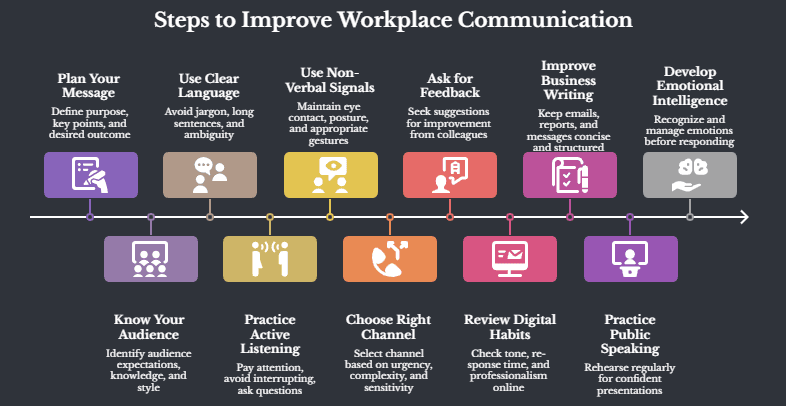
- Know Your Audience- Identify who you are communicating with, their expectations, knowledge level, and preferred communication style.
- Plan Your Message Before Communicating- Define your purpose, key points, and desired outcome before speaking or writing.
- Use Clear and Simple Language- Avoid unnecessary jargon, long sentences, and ambiguous wording.
- Practice Active Listening- Pay attention, avoid interrupting, ask clarifying questions, and confirm your understanding.
- Improve Business Writing- Keep emails, reports, and messages concise, structured, professional, and easy to scan.
- Pay Attention to Non-Verbal Signals- Use appropriate eye contact, facial expressions, posture, tone, and gestures.
- Ask for and Use Feedback- Ask colleagues or managers what you can improve and apply their suggestions.
- Choose the Right Communication Channel- Match the channel to the urgency, complexity, sensitivity, and documentation needs of the message.
- Practice Public Speaking and Presentations- Rehearse regularly, organize ideas logically, and focus on confident delivery.
- Develop Emotional Intelligence- Recognize your emotions and understand how others may feel before responding.
- Review and Improve Digital Communication Habits- Check tone, response time, clarity, formatting, and professionalism across digital platforms.
Common Business Communication Mistakes to Avoid
Effective business communication is not only about what you say but also how, when, and to whom you say it. Avoiding common communication mistakes can help you reduce misunderstandings, improve workplace relationships, and communicate more professionally.
Let's have a look at each,
Using Vague Language
Avoid unclear words, general statements, or messages that leave room for multiple interpretations. Be specific about expectations, deadlines, responsibilities, and outcomes.
Writing Unnecessarily Long Messages
Long messages can make it difficult for readers to identify the main point. Keep workplace communication concise and focus on the information the recipient needs to take action.
Ignoring the Audience
A message should reflect the recipient's role, knowledge, and expectations. Avoid using technical terms or providing excessive detail when the audience may not need them.
Poor Listening
Communication can break down when people focus only on responding rather than understanding. Listen carefully, avoid interrupting, and ask questions when something is unclear.
Using the Wrong Tone
The wrong tone can make a message sound rude, dismissive, or overly casual. Consider the situation and relationship before choosing your words, especially when discussing problems or giving feedback.
Sending Messages Without Proofreading
Typos, grammatical errors, incorrect names, or missing information can affect your credibility. Take a moment to review important emails, reports, and messages before sending them.
Choosing the Wrong Communication Channel
Not every message belongs in an email or instant message. Use calls or direct messages for urgent matters, written communication when documentation is important, and meetings for complex discussions.
Providing Too Much Information
Including unnecessary details can distract from the main message. Share relevant information first and provide additional context only when it helps the recipient understand or act on the message.
Failing to Ask for Feedback
Without feedback, you may not know whether your message was understood correctly. Encourage questions and ask recipients to clarify their understanding when the topic is important.
Making Assumptions or Relying on Stereotypes
Avoid assuming what someone knows, thinks, or prefers based on their role, background, age, or other characteristics. Communicate with individuals based on the actual context and information available.
Business Communication Mistakes Checklist
Check if,
- the message clear and specific?
- Have you removed unnecessary information?
- Have you considered your audience?
- Are you listening and responding appropriately?
- Does your tone suit the situation?
- Have you proofread the message?
- Are you using the right communication channel?
- Have you included only relevant information?
- Have you allowed room for questions or feedback?
- Have you avoided assumptions and stereotypes?
Business Communication in the Digital Workplace
Digital workplaces rely on emails, messaging apps, video meetings, and collaborative tools. Using these channels effectively helps teams stay clear, productive, and connected.
- Email Communication: Use clear subject lines, concise messages, professional language, and specific calls to action.
- Video Meetings: Join on time, review the agenda, avoid interruptions, and stay engaged throughout the meeting.
- Workplace Messaging: Keep messages brief and relevant. Use the right channel and avoid unnecessary messages.
- Collaborative Documents: Use comments, suggestions, version history, and clear file names to support smooth collaboration.
- Remote and Hybrid Team Communication: Share updates regularly, document decisions, respect working hours, and keep responsibilities clear.
- Digital Communication Etiquette: Maintain a professional tone, proofread messages, respond appropriately, and respect colleagues' availability.
Business Communication Syllabus: Common Topics Students Study
The business communication syllabus varies by university, course level, and program structure. However, most programs cover core concepts related to workplace communication, professional writing, presentations, and interpersonal skills.
Common Topics in a Business Communication Syllabus
Module | Common Topics |
Module 1: Communication Basics | Meaning and scope of communication, communication process, elements of communication |
Module 2: Types of Communication | Verbal and non-verbal communication, formal and informal communication, upward and downward communication |
Module 3: Communication Barriers | Physical, language, cultural, psychological, and organisational barriers |
Module 4: Business Writing | Business letters, reports, notices, memos, emails, and digital communication |
Module 5: Listening and Speaking | Listening skills, speaking skills, presentations, and professional conversations |
Module 6: Group Communication | Group discussions, meetings, teamwork, and workplace collaboration |
Module 7: Career Communication | Interviews, resumes, professional introductions, and workplace interactions |
Module 8: Professional Communication | Business etiquette, communication ethics, and cross-cultural communication |
Note: The exact subjects, modules, assessment methods, and semester-wise structure can differ across universities and programs. Students should check their institution's official syllabus for the most accurate details.
Best Books for Learning Business Communication
The best business communication books depend on your syllabus, academic level, and whether you want theoretical concepts or practical workplace skills. For students, it is useful to choose books that cover business writing, presentations, interviews, reports, workplace etiquette, and digital communication.
Book | Best For |
Business Communication, 4th Edition - R.K. Madhukar | BBA, B.Com and MBA students |
Business Communication - K.K. Sinha | Management and commerce students |
Essentials of Business Communication - Rajendra Pal & J.S. Korlahalli | BBA and MBA students |
Business Correspondence and Report Writing - R.C. Sharma & Krishna Mohan | Students improving professional writing |
Business Communication: Process & Product - Mary Ellen Guffey & Dana Loewy | Students seeking comprehensive coverage |
HBR Guide to Better Business Writing - Bryan A. Garner | Professionals and advanced learners |
HBR Guide to Persuasive Presentations - Nancy Duarte | Students and professionals |
Business Communication for Students and Working Professionals
Business communication skills are valuable at different stages of a career. Students use them to prepare for professional opportunities, while working professionals rely on them for effective workplace collaboration and career growth.
Students | Working Professionals |
Interviews: Communicate confidently with recruiters. | Team Collaboration: Coordinate clearly with colleagues. |
Group Discussions: Share ideas and respond effectively. | Leadership: Communicate goals and guide teams. |
Presentations: Present academic topics with confidence. | Client Communication: Build clear and professional client relationships. |
Internships: Communicate effectively in professional settings. | Reporting: Share updates, findings, and business information clearly. |
Academic Projects: Collaborate and present project outcomes. | Negotiation: Communicate interests and reach agreements. |
Workplace Readiness: Build professional communication habits. | Career Growth: Strengthen professional presence and advancement opportunities. |
Conclusion
Business communication is an essential skill for students and professionals to share ideas, collaborate effectively, and build strong workplace relationships. Developing clear, confident, and professional communication can provide academic success, workplace performance, and long-term career growth.
Key Takeaways
- Clear communication helps reduce misunderstandings and improves productivity.
- Active listening is essential for effective workplace interactions.
- Choosing the right communication channel improves message effectiveness.
- Professional writing should be clear, concise, and well-structured.
- Presentations, interviews, and group discussions require confident communication.
- Digital communication requires appropriate tone, etiquette, and professionalism.
- Feedback helps identify and improve communication gaps.
- Students can use communication skills to improve workplace readiness.
- Professionals can strengthen collaboration, leadership, negotiation, and career growth through effective communication.
If you want to build job-ready business and communication skills, Talk to a Counsellor to explore suitable online degree or management programs based on your career goals.