Importance of Corporate Accounting
Corporate accounting helps businesses manage their financial activities in an organized way. It supports accurate reporting, better planning, compliance, and informed decision-making.
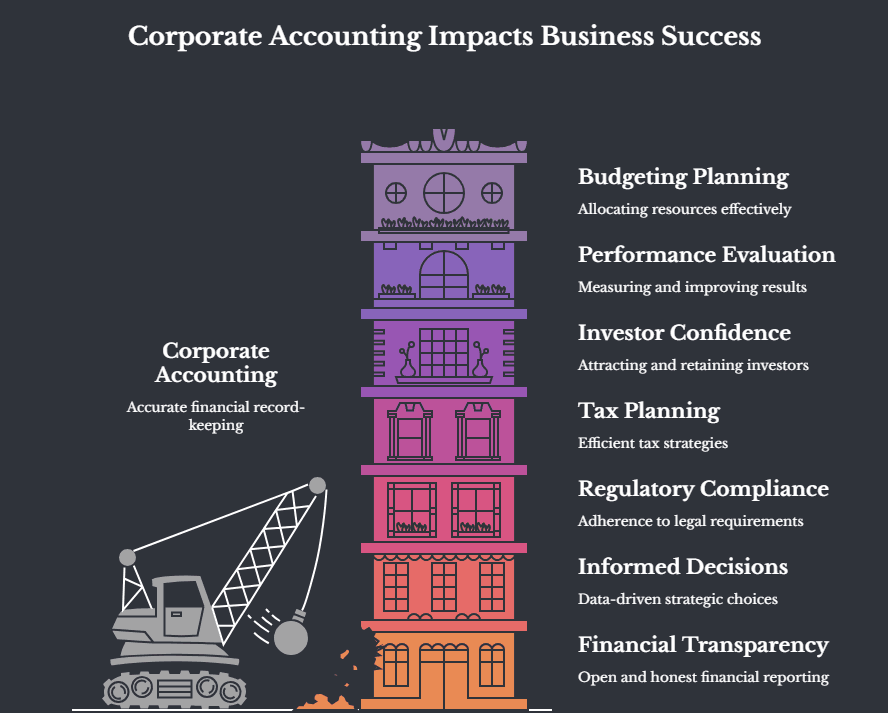
Financial Transparency
- Provides a clear view of a company's financial position.
- Records of income, expenses, assets, and liabilities systematically.
- Helps stakeholders understand business performance.
Informed Decision-Making
- Provides reliable financial data for important business decisions.
- Helps analyze revenue, expenses, profits, and costs.
- Supports decisions related to investments, expansion, and spending.
Regulatory and Statutory Compliance
- Helps companies maintain required financial records.
- Supports compliance with applicable accounting and reporting requirements.
- Makes it easier to prepare financial reports and documentation.
Tax Planning and Reporting
- Helps track income, expenses, and taxable transactions.
- Supports the calculation of taxable income.
- Assists with timely tax planning and reporting.
Investor and Stakeholder Confidence
- Provides organized financial information to stakeholders.
- Helps investors and lenders assess company performance.
- Promotes transparency and confidence in financial reporting.
Performance Evaluation
- Helps measure financial performance over time.
- Allows companies to review revenue, expenses, and profits.
- Identifies areas that need improvement or further attention.
Budgeting and Financial Planning
- Uses financial data to prepare budgets and future.
- Helps estimate costs and financial requirements.
- Supports better resource allocation and spending decisions.
Accurate Financial Record-Keeping
- Ensure business transactions are recorded systematically.
- Makes financial tracking and reporting easier.
- Supports auditing, analysis, and compliance-related processes.
Key Objectives of Corporate Accounting
The objectives of corporate accounting focus on what a company aims to achieve through its accounting system. Unlike its importance, which explains why corporate accounting is valuable, these objectives define the specific outcomes of accounting activities.
- Record Financial Transactions Accurately
To systematically record business transactions such as sales, purchases, expenses, investments, and payments. This creates an organized financial record of the company's activities.
- Prepare Financial Statements
To compile accounting information into relevant financial statements. These statements present the company's financial position and performance for a specific accounting period.
- Measure Financial Performance
To determine the financial results of business operations by analyzing income, expenses, profits, and losses. This helps assess how the company performs during a particular period.
- Monitor Assets and Liabilities
To maintain proper records of what the company owns and what it owes. This helps track changes in its financial position over time.
- Support Management Decisions
To provide relevant financial information that management can use while evaluating business activities and making operational or strategic decisions.
- Meet Reporting and Compliance Requirements
To maintain accounting records and prepare financial information in line with applicable reporting, legal, and regulatory requirements.
- Provide Information to Stakeholders
To communicate relevant financial information to investors, lenders, shareholders, and other stakeholders who need to assess the company's financial position.
- Maintain Financial Accountability
To create a systematic record of how company funds and resources are used, helping establish responsibility for financial transactions and activities.
Also Read: Learn More About Business Communication used in Corporate Accounting
Types and Key Areas of Corporate Accounting
Corporate accounting includes different accounting disciplines that help companies manage, analyze, and report financial information. It also covers several day-to-day operational areas that support smooth financial management.
Let's have a look at each,
Core Types of Corporate Accounting
- Financial Accounting: Focuses on recording business transactions and preparing financial statements, such as the balance sheet, income statement, and cash flow statement.
- Managerial Accounting: Provides financial and cost-related information to management for planning, budgeting, performance analysis, and internal decision-making.
- Tax Accounting: Deals with maintaining records for tax purposes, calculating tax liabilities, and supporting tax reporting and compliance.
- Cost Accounting: Focuses on identifying and analyzing costs related to materials, labor, production, and business operations to support cost control.
Daily Operational Areas
- Accounts Payable and Receivable: Involves tracking money owed to suppliers and amounts that customers need to pay to the company.
- Payroll Management: Covers the calculation and processing of employee salaries, bonuses, deductions, and other payroll-related payments.
- Internal Controls and Auditing: Helps monitor financial processes, review records, and identify potential errors or irregularities.
- Strategic Compliance: Supports adherence to applicable reporting and governance requirements while addressing evolving areas such as sustainability and ESG-related reporting.
Corporate Accounting Process: Step-by-Step
The corporate accounting process follows a structured approach to record, organize, check, and report a company's financial transactions.
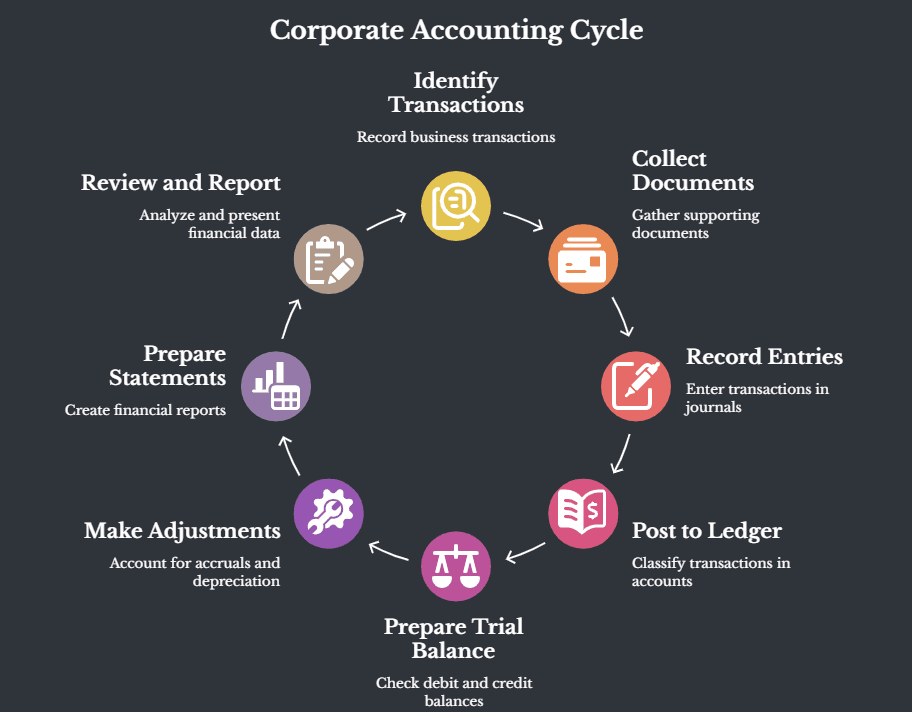
Step 1: Identify Financial Transactions
Identify business transactions that need to be recorded, such as sales, purchases, expenses, payments, and investments.
Step 2: Collect and Verify Source Documents
Gather supporting documents, including invoices, bills, receipts, and bank records, and verify the transaction details.
Step 3: Record Journal Entries
Record each transaction in the books of accounts using the appropriate accounting principles and entries.
Step 4: Post Transactions to the Ledger
Transfer and classify journal entries into relevant accounts, such as cash, sales, expenses, assets, and liabilities.
Step 5: Prepare a Trial Balance
Prepare a trial balance to check whether debit and credit balances are properly recorded and matched.
Step 6: Make Necessary Adjustments
Record adjustments for items such as accrued expenses, depreciation, prepaid expenses, or other applicable entries.
Step 7: Prepare Financial Statements
Use the accounting records to prepare key financial statements, such as the balance sheet, statement of profit and loss, and cash flow statement.
Step 8: Review and Report Financial Information
Review the financial information to identify errors or important insights and prepare relevant reports for management and other stakeholders.
Main Components of Corporate Accounting
The main components of corporate accounting represent the key financial elements used to record, classify, and understand a company's financial position and performance.
Component | Meaning | Example |
Assets | Resources owned or controlled by a company that has economic value. | Cash, equipment, or inventory |
Liabilities | Amounts a company owes to external parties. | Bank loans or unpaid supplier bills |
Equity | The owners' residual interest in the company's assets after liabilities. | Share capital and retained earnings |
Revenue | Income earned from a company's primary business activities. | Sales of products or services |
Expenses | Costs incurred while running business operations. | Salaries, rent, and utility costs |
Profit and Loss | The financial result after comparing revenue with expenses for a period. | Profit when revenue exceeds expenses |
Accounts Receivable | Money is owed to the company by customers. | Credit sales awaiting payment |
Accounts Payable | Money the company owes to suppliers or vendors. | Unpaid purchase invoices |
Corporate Accounting Principles and Standards
Corporate accounting follows key principles and standards to help companies prepare financial information in a consistent, reliable, and transparent manner.
The applicable accounting standards and requirements may vary based on the company, jurisdiction, and regulatory framework.
Principle or Standard | Meaning |
Consistency | Companies should apply accounting methods consistently to make financial information easier to compare over time. |
Accuracy | Financial transactions and records should be recorded correctly and supported by relevant information. |
Transparency | Financial reporting should clearly present relevant information and disclosures to users of financial statements. |
Accrual Principle | Transactions are generally recognized when they occur rather than only when cash is received or paid. |
Going Concern Principle | Financial statements are generally prepared on the assumption that the business will continue operating for the foreseeable future, unless otherwise applicable. |
Matching Principle | Relevant expenses are recognized in relation to the revenue or period they help generate. |
Materiality | Information that could influence users' understanding or decisions should receive appropriate attention and disclosure. |
Applicable Accounting Standards | Corporate accounting must follow the accounting standards, reporting requirements, and regulations applicable to the company and its jurisdiction. |
Corporate Accounting vs Financial Accounting
Financial accounting is an important part of corporate accounting, while corporate accounting covers a broader range of accounting activities related to companies and corporate entities.
Below given is the difference between the two accounting concepts,
Basis | Corporate Accounting | Financial Accounting |
Scope | Covers the accounting activities and financial matters of companies and corporate entities. | Focuses on recording transactions and preparing financial statements and reports. |
Application | Primarily associated with companies and corporate organizations. | Can be used by different types of businesses and organizations. |
Focus | Covers corporate transactions, financial reporting, compliance, and other company-specific accounting requirements. | Primarily focuses on financial recording, classification, and reporting. |
Users | Supports management, shareholders, regulators, investors, and other stakeholders. | Provides financial information to internal and external users. |
Key Activities | May include financial reporting, corporate compliance, tax-related accounting, and management of company accounts. | Includes recording transactions and preparing financial statements such as the balance sheet and statement of profit and loss. |
Corporate Accounting vs Management Accounting
Corporate accounting has a broader focus on managing and reporting a company's financial activities, while management accounting mainly provides information for internal planning and decision-making.
Let's have a look at the difference between the two concepts in more detail,
Basis | Corporate Accounting | Management Accounting |
Primary Focus | Focuses on company-wide financial transactions, accounting, reporting, and related compliance requirements. | Focuses on analyzing information for internal planning, control, and decision-making. |
Main Users | Used by management, shareholders, investors, regulators, and other stakeholders. | Primarily used by managers and internal decision-makers. |
Information Used | Mainly use financial records, transactions, and company financial reports. | Uses both financial and operational information, such as costs, budgets, and performance data. |
Key Purpose | Supports financial reporting, accountability, compliance, and management of company accounts. | Supports planning, budgeting, performance evaluation, and business improvement. |
Reporting Focus | May involve preparing information for both internal use and external reporting requirements. | Primarily prepares reports and analysis for internal use. |
Nature of Information | Generally, focuses on the overall financial activities and position of the company. | Provides detailed and forward-looking analysis to support specific management decisions. |
Applications and Examples of Corporate Accounting
Corporate accounting is used across different business functions to record, analyses, and manage financial information. Let's explore its application and examples of corporate accounting.
Application | Example |
Financial Reporting | Preparing financial statements at the end of an accounting period to understand the company's financial position and performance. |
Budgeting and Planning | Using past financial data to create budgets, estimate future expenses, and plan how resources will be used. |
Tax Compliance | Maintaining organized financial records to support tax calculations, reporting, and filing requirements. |
Cash Flow Management | Tracking money received from customers and monitoring accounts receivable to manage day-to-day cash needs. |
Expense Management | Recording salaries, reimbursements, rent, and other business expenses to keep spending under control. |
Asset Management | Maintaining records of company assets and accounting for items such as depreciation over their useful life. |
Performance Analysis | Reviewing revenue, expenses, and profitability to understand how the business is performing. |
Investment Decisions | Using corporate accounting information to assess the financial impact of a new project, asset purchase, or business opportunity. |
Internal Controls | Monitoring financial transactions and processes to improve accuracy, accountability, and record-keeping. |
Business Decision-Making | Providing financial information that helps management make decisions related to spending, operations, growth, and planning. |
What Is Advanced Corporate Accounting?
Advanced corporate accounting is the study of complex financial transactions and accounting practices followed by companies. It goes beyond basic accounting and covers topics related to company structure, financing, mergers, and financial reporting.
It may include:
- Company Accounts: Preparing and managing company financial accounts.
- Shares: Accounting for the issue and redemption of shares.
- Debentures: Recording and managing funds raised through company borrowings.
- Business Combinations: Accounting when companies merge or combine.
- Amalgamation and Reconstruction: Recording company mergers, restructuring, or reorganization.
- Consolidated Financial Statements: Combining the accounts of a parent company and its subsidiaries.
- Holding Company Accounts: Managing accounts related to parent-subsidiary relationships.
- Liquidation: Accounting for the settlement of accounts when a company is wound up.
- Advanced Financial Reporting: Preparing detailed financial reports and disclosures for complex business transactions.
Common Mistakes to Avoid in Corporate Accounting
Even small errors in corporate accounting can affect financial records, reporting, and decision-making.
Use this checklist to avoid common mistakes:
- Recording transactions incorrectly: Check transaction details and amounts before entering them into the accounts.
- Using incomplete supporting documents: Maintain proper invoices, receipts, bills, and other records for each transaction.
- Misclassifying accounts: Ensure assets, liabilities, revenue, and expenses are recorded under the correct accounts.
- Skipping regular reconciliations: Reconcile bank accounts and other balances regularly to identify discrepancies.
- Ignoring applicable accounting standards: Follow the accounting standards and reporting requirements relevant to the company.
- Missing reporting deadlines: Track important deadlines for financial statements, tax filings, and other required reports.
- Making calculations: Review calculations carefully and use reliable accounting systems where appropriate.
- Maintaining poor documentation: Keep financial records organized and easily accessible for review or audit purposes.
- Not reviewing financial statements: Regularly review financial reports to identify errors, unusual changes, or important trends.
- Relying on outdated accounting practices: Keep accounting processes updated in line with applicable standards, regulations, and business needs.
How to Learn Corporate Accounting
Learning corporate accounting becomes easier when you build your knowledge step by step. Start with the basics, practice regularly, and gradually move towards more complex topics.
Step 1: Learn Basic Accounting Concepts
Begin by understanding basic terms such as assets, liabilities, equity, revenue, expenses, profit, and loss. These concepts form the foundation for learning corporate accounting.
Step 2: Understand the Accounting Equation
Learn how the relationship between assets, liabilities, and equity works. Learn about the accounting equation helps you see how every business transaction affects a company's financial position.
Step 3: Study Journal Entries and Ledger Posting
Learn how financial transactions are first recorded through journal entries and then classified into different ledger accounts. Practice entries for common transactions such as sales, purchases, expenses, and payments.
Step 4: Learn Company-Specific Accounting Concepts
Move on to topics related specifically to company accounts, such as shares, debentures, financial reporting, and other corporate transactions. This is an important step in understanding corporate accounting practice.
Step 5: Practice Preparing Financial Statements
Learn how accounting information is used to prepare key financial statements, including the balance sheet, statement of profit and loss, and cash flow statement.
Step 6: Solve Practical Accounting Problems
Apply what you learn by solving numerical problems and practical case-based questions. Regular practice can help you understand how corporate accounting concepts work in real situations.
Step 7: Learn Spreadsheets and Relevant Accounting Tools
Develop basic skills in spreadsheets and accounting software used to organize, analyze, and manage financial data. These skills can also make you more prepared for practical accounting work.
Step 8: Study Advanced Corporate Accounting Topics
Once you understand the basics, check out advanced corporate accounting topics based on your academic or career goals. You can study areas such as business combinations, amalgamation, consolidated financial statements, holding company accounts, and advanced financial reporting.
Further Read: Online BCom Syllabus wherein you can learn about corporate accounting
Emerging Trends in Corporate Accounting
Corporate accounting is changing with the growing use of technology, data, and new reporting requirements. For students and aspiring accountants, it is important to stay updated with these changes.
Below mentioned are emerging trends in corporate accounting
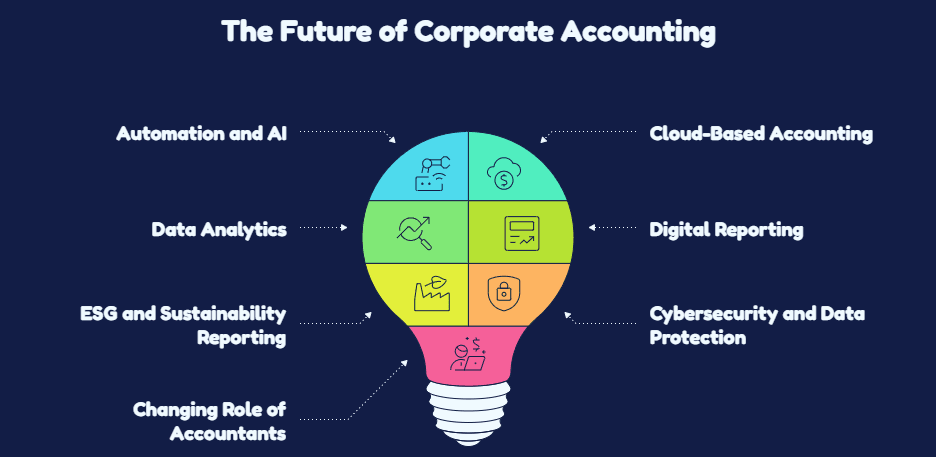
Automation and AI
- Companies are increasingly using automation and Artificial Intelligence (AI) to handle repetitive accounting tasks such as data entry, invoice processing, reconciliations, expense tracking, and financial analysis.
- According to Intuit's Technology Survey, 95% of accounting firms have automated at least one operational function, while 64% plan to invest further in AI capabilities.
- Rather than replacing accountants, AI is helping professionals spend less time on routine work and more time on strategic decision-making and advisory services.
Cloud-Based Accounting
- Businesses are increasingly adopting cloud accounting platforms that provide real-time access to financial information from anywhere.
- Cloud systems improve collaboration between finance teams, management, auditors, and external stakeholders while reducing dependency on paper-based records.
- These platforms also enable faster updates, automated backups, and improved scalability, making financial management more efficient.
Data Analytics and Business Insights
- Modern accounting is moving beyond recording transactions to generating actionable business insights.
- Organizations use financial data analytics to identify trends, forecast future performance, manage risks, and support strategic planning.
- As businesses generate larger volumes of data, accountants who can interpret and communicate data-driven insights are becoming highly valuable.
Digital Reporting
- Stakeholders increasingly expect financial information to be available faster and in more accessible digital formats.
- Companies are adopting technology-enabled reporting systems that improve reporting speed, accuracy, and transparency.
- Digital reporting also helps management make timely decisions based on real-time financial information rather than waiting for periodic reports.
ESG and Sustainability Reporting
- Investors, regulators, and customers are placing greater emphasis on Environmental, Social, and Governance (ESG) performance.
- As a result, organizations are expanding their reporting to include information on carbon emissions, diversity initiatives, employee welfare, ethical practices, and sustainability goals.
- Accountants play an important role in collecting, measuring, verifying, and reporting ESG-related data alongside traditional financial information.
Cybersecurity and Data Protection
- As accounting systems become more digital, protecting sensitive financial data has become a top priority.
- Organizations are investing in stronger cybersecurity measures, access controls, encryption technologies, and data protection frameworks.
- Accountants are increasingly expected to understand data security risks and support compliance with privacy and security regulations.
Changing Role of Accountants
- The role of accountants is shifting from traditional bookkeeping and compliance-focused work to strategic business partnerships.
- Research shows that accountants are spending more time on advisory and decision-support activities as automation reduces manual tasks.
- Today's professionals need a combination of accounting knowledge, technology proficiency, analytical thinking, communication skills, and business acumen to succeed in a rapidly changing workplace.
- For students entering the field, continuous learning and digital skill development will be key to long-term career growth.
Conclusion
To conclude, corporate accounting is an important area of accounting for students interested in understanding how companies manage, record, and report their financial activities.
If you want to build relevant knowledge and skills in this field, you can Talk to a Counsellor to explore suitable Online BCom or Online MCom programs on Your Degree and choose a learning path aligned with your career goals.