Marks vs Grades: What's the Difference?
Marks | Grades |
Numerical score obtained in exams | Performance category assigned to marks |
Example: 78/100 | Example: Grade A |
Evaluates individual exam performance | Evaluates overall academic achievement |
Read: UGC-DEB Approved Online BCA Universities
How the Online BCA Grading Process Works
Online BCA evaluation usually combines continuous assessment with semester-end examinations. This ensures students are assessed consistently throughout the semester rather than solely through final exams.

Assignments
Assignments are one of the most important components of the Online BCA evaluation process. They help assess a student's understanding of concepts, practical application skills, and consistency throughout the semester.
Assignments may include:
- Coding exercises and programming tasks
- Problem-solving activities
- Subject-specific projects
Internal Assessment
Internal assessment contributes a percentage of the final grade and measures a student's engagement and performance during the semester.
Common components include:
- Lab practical submissions
- Discussion forum participation
- Attendance (where applicable)
Students comparing different learning formats can also explore how assessment methods differ in an Online BCA vs Regular BCA program.
End Semester Examination
The end semester examination forms a major part of the final evaluation.
It generally includes:
- Viva voce (where applicable)
Depending on the university, exams may be conducted online through remote proctoring or at designated examination centers.
Weightage Distribution
The exact weightage varies by university, but most institutions follow a similar model.
Typical Evaluation Weightage
Component | Typical Weightage |
Internal Assessment | 30% |
End Semester Examination | 70% |
Note: Some universities may follow a 25:75 or 40:60 distribution. Always check your university's academic handbook.
Online BCA Credit System Explained
Many students confuse credits with marks, but they serve entirely different purposes.
Credits represent the academic value and workload associated with a subject. Subjects requiring more study hours, practical work, or technical understanding typically carry more credits.
Why Do Subjects Have Different Credits?
A programming subject may involve coding, lab sessions, projects, and examinations, making it more intensive than a communication skills course.
Similarly:
- Core subjects generally have higher credits
- Lab courses carry separate credits
- Projects often have significant credit weightage
Sample Credit Distribution
Before understanding CGPA calculations, it is important to see how credits are typically assigned across subjects.
Subject | Credits |
Programming | 4 |
Mathematics | 4 |
Communication Skills | 2 |
Computer Lab | 2 |
How is CGPA Calculated in an Online BCA?
This is one of the most frequently asked questions among BCA students. To understand CGPA calculation, you first need to know the difference between SGPA and CGPA.
SGPA vs CGPA: Key Differences
Let's have a look at the difference between SGPA and CGPA for online BCA
SGPA | CGPA |
Semester-specific score | Program-wide score |
Calculated every semester | Calculated after combining all semesters |
Reflects short-term performance | Reflects overall performance |
CGPA Calculation Example
Let's understand the process with a simple example.
Subject-wise Performance
Subject | Credits | Grade Point |
Programming | 4 | 9 |
Mathematics | 4 | 8 |
DBMS | 3 | 9 |
English | 2 | 8 |
Step 1: Calculate Credit Points
Subject | Credits | Grade Point | Credit Points |
Programming | 4 | 9 | 36 |
Mathematics | 4 | 8 | 32 |
DBMS | 3 | 9 | 27 |
English | 2 | 8 | 16 |
Total Credit Points = 111
Total Credits = 13
Step 2: Calculate SGPA/CGPA
CGPA = Total Credit Points ÷ Total Credits
CGPA = 111 ÷ 13 = 8.54
This method is known as a credit-weighted calculation, and most universities use a variation of this formula.
How to Convert Online BCA CGPA into Percentage
Students often need percentage conversions for job applications, higher education admissions, scholarships, and government recruitment processes.
However, there is no universal formula followed by every university.
Common CGPA-to-Percentage Conversion Methods
Some universities use:
- Percentage = (CGPA − 0.5) × 10
- Institution-specific conversion formulas
Approximate Percentage Conversion Reference
The following table provides a general reference and should not replace your university's official conversion guidelines.
CGPA | Approximate Percentage |
6 | 55% - 60% |
7 | 65% - 70% |
8 | 75% - 80% |
9 | 85% - 90% |
Important Note: Always verify your university's official conversion policy.
Online BCA Passing Marks and Graduation Requirements
Apart from maintaining a good CGPA, students must meet the minimum passing requirements set by their university.
While criteria vary slightly across institutions, most online BCA programs require students to pass theory, practical, and project components separately.
Typical Passing Criteria
Requirement | Typical Criteria |
Theory Exam | 40% |
Practical Exam | 40% |
Internal Assessment | Minimum qualifying marks |
Overall CGPA | 5.0 - 6.0 |
Important Points
- Failure in one component may lead to a backlog.
- Practical subjects often have separate passing requirements.
- Graduation may require clearing all subjects and maintaining a minimum CGPA.
Always refer to the university's academic regulations for exact requirements.
Online BCA Backlog Rules Explained
Backlogs are among the biggest concerns for students pursuing a BCA degree. Understanding backlog rules can help you handle academic challenges more confidently.
"A backlog refers to a subject that a student fails to clear during a semester due to insufficient marks or failure to meet eligibility requirements."
The backlog must be cleared through a future examination attempt.
Common Reasons for Backlogs
Students typically receive backlogs due to:
- Failure in practical exams
- Low internal assessment marks
- Non-submission of assignments
- Absence during examinations
Backlog Examinations
Most universities provide opportunities to clear backlogs through:
- Supplementary Exams: Special examinations conducted after regular semester exams.
- Reappear Exams: Students retake the failed subject examination during the next eligible examination cycle.
- Improvement Exams: Some universities allow score improvement after passing a subject.
What are the Maximum Attempts for Backlogs in an Online BCA?
- Universities have different policies regarding maximum reappears and completion timelines.
- Students are usually given multiple opportunities to clear failed subjects within the overall program duration.
Does a Backlog Affect CGPA?
Yes, it can.
A backlog may:
- Lower your SGPA in the affected semester
- Delay CGPA improvement
- Impact eligibility for some internships or placements
However, once the subject is cleared, the updated grade may be included according to university regulations.
Backlog Clearance Process
Below given is a backlog clearance process for the online bca process
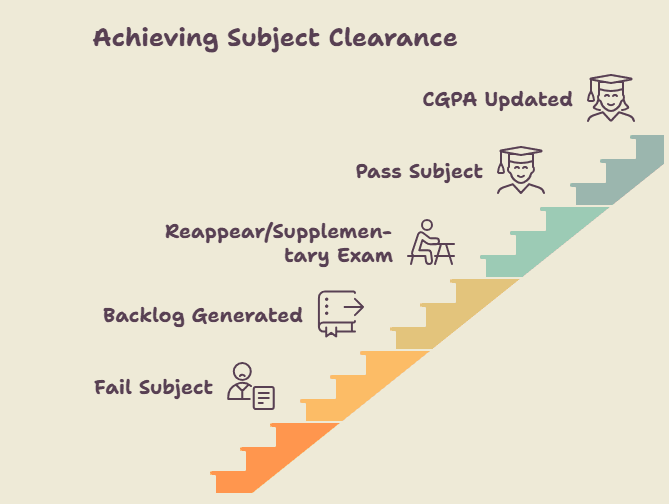
Fail Subject
↓
Backlog Generated
↓
Reappear/Supplementary Exam
↓
Pass Subject
↓
CGPA Updated
Does the Grading System Differ Across Online BCA Universities?
While most online BCA programs follow CBCS or similar credit-based frameworks, there can be variations in grading scales, evaluation methods, and conversion formulas.
Before comparing universities, remember that grading structures are often institution-specific.
Sample Comparison
Parameter | University A | University B |
Grade Scale | 10 Point | 10 Point |
Internal Marks | 30 | 25 |
Passing Marks | 40% | 45% |
CGPA Formula | Credit-Based | Credit-Based |
Students should always consult the official academic handbook for accurate information. One can compare grading policies, curriculum structure, and evaluation patterns before selecting from the Best Online Private BCA colleges in India.
Why Understanding the Grading System Matters
Your academic scores influence much more than semester results.
A strong CGPA can create opportunities across multiple career and educational pathways.
Understanding the grading system is important for:
- Government job eligibility
- International higher education opportunities
For many MCA and MBA programs, applicants must submit either CGPA or percentage scores during admission. Keep in mind that your academic performance and CGPA often play an important role during Online MCA admission after BCA. Similarly, recruiters often use academic performance as an initial screening criterion.
Tips to Maintain a High CGPA Throughout Your Online BCA
Maintaining a strong CGPA requires consistency rather than last-minute exam preparation. Below are some practical strategies that successful students commonly follow:
- Submit assignments before deadlines
- Focus on high-credit subjects first
- Prepare for semester exams early
- Strengthen practical and lab performance
- Clear backlogs as soon as possible
- Track SGPA every semester
- Use quizzes and internal assessments to improve scores
- Understand your university's grading policy from Day 1
CGPA Improvement for Online BCA: Quick Checklist
- Complete weekly study targets
- Maintain assignment schedule
- Track internal assessment scores
- Review weak subjects monthly
- Practice coding regularly
- Attend practical sessions consistently
- Monitor SGPA every semester
- Address backlogs immediately
Along with understanding grading policies, students should also be aware of tuition costs and university offerings before making a final decision. Read Online BCA Fees in India.
Conclusion
Online BCA grading system helps you track your academic performance, calculate your SGPA and CGPA accurately, and stay informed about percentage conversion, passing criteria, and backlog rules. Since grading policies may vary across universities, always refer to your institution's official academic guidelines.
If you're planning to pursue an Online BCA and need help choosing the right university, talk to a counsellor for personalized guidance on admissions, curriculum, fees, and career opportunities.