“Management is the way of getting things done via different people working in an organization”. It coordinates with people, resources, and processes to achieve business goals efficiently and effectively.
- Improves coordination: Aligns teams and resources toward common objectives.
- Increases efficiency: Helps use time, money, and resources effectively.
- Supports decision-making: Guides managers in planning and solving business problems.
- Drives growth: Helps organizations adapt to changes and achieve long-term goals.
This article covers the importance of management, including its functions, and why effective management is essential to organizational success.
Want to Build Strong Management Skills? Then check out UGC-entitled Online BBA & Online MBA programs and choose a specialization that aligns with your career goals.
What Is the Importance of Management in an Organization?
Management is important in an organization because it gives employees a clear direction and coordinates resources to achieve common business goals.
Let's discuss the importance of management in detail,
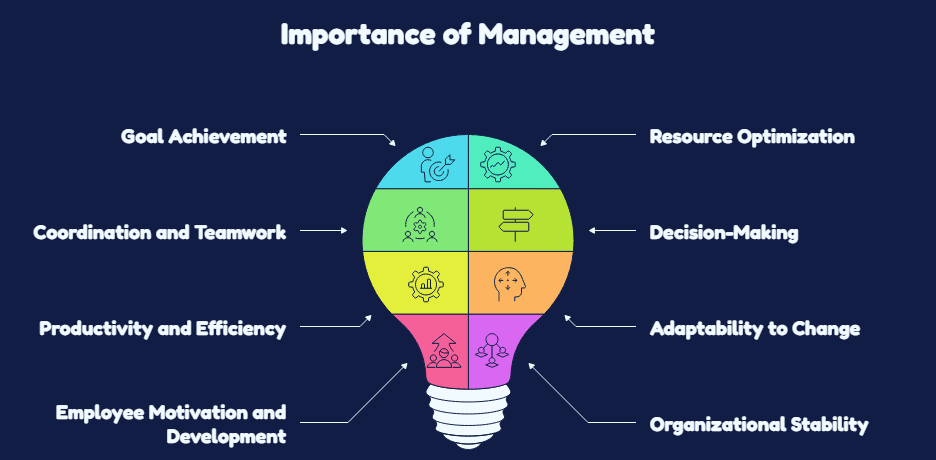
1. Helps Achieve Organizational Goals
Management plays an important role in converting organizational objectives into specific and measurable goals. It assists management in guiding workers, assigning responsibilities, and monitoring their performance so that all activities become consistent with organizational goals.
- Setting goals: Defining specific and attainable organizational goals.
- Assigning responsibilities: Assigning tasks according to the role of workers.
- Monitoring progress: Monitoring performance against the set goals.
- Corrective action: Taking corrective measures when there are deviations from set goals.
2. Ensures Effective Use of Resources
One of the main factors associated with the importance of management includes the effective utilization of existing resources. The managers utilize their plans and resources as per the organizational needs by avoiding any kind of unnecessary wastage and expenditure.
- Human resources: Allocates employees to appropriate job positions and tasks.
- Financial resources: Develops budgets and controls unnecessary expenditures.
- Time and technology: Makes sure that working time and technology are used efficiently.
- Materials and infrastructure: Efficiently manages materials and infrastructure.
3. Improves Coordination and Teamwork
Management helps bring various employees and teams within an organization on the same page. Coordination helps eliminate ambiguity and helps ensure that all activities in the organization are linked together.
- Interdepartmental coordination: Helps link the activities of various departments.
- Communication: Helps communicate the information to the right persons at the right time.
- Delegation: Helps delegate powers and responsibility among the employees.
- Collaboration: Helps promote teamwork among employees.
4. Supports Better Decision-Making
Managers make valuable contributions to the decision-making process in regard to operations and overall business performance. In this context, managers collect data, analyze alternatives, and evaluate the outcome of a particular situation.
- Problem identification: Identifies the problem that might affect organizational performance.
- Alternatives analysis: Analyses the alternatives in terms of the decision being made.
- Risk assessment: Considers the risk involved in making the decision.
- Decision-making: Makes a decision without any undue delay.
5. Increases Productivity and Efficiency
Proper management helps an organization improve its planning and execution process through process improvement, performance monitoring, reduction of wastage, and time management.
- Process Improvement: Involves identifying and improving the inefficiencies within the process.
- Performance Monitoring: Involves monitoring the performance of employees and teams.
- Reduction of Wastage: Avoids wastage of resources.
- Time Management: Improves proper time management within teams.
6. Helps Organizations Adapt to Change
Firms encounter numerous changes in terms of technology, customers, market, and competition. Management plays an important role in helping firms cope with such changes and develop their strategies and processes, as well as employees, accordingly.
- Change management: Planning and managing organizational changes.
- Technology adaptation: Implementing necessary technologies.
- Employee adaptation: Preparing employees to adapt to new processes.
- Market adaptation: Developing business strategy based on market requirements.
7. Motivates and Develops Employees
Management also concentrates on employee performance, motivation, and professional development. Management may help to provide a conducive environment through feedback, recognition, and training of employees.
- Feedback: Guides employees on how to improve their performance.
- Recognition: Appreciates the contributions of employees.
- Training & Development: Helps employees to develop necessary skills.
- Performance Management: Defines expectations and monitors the performance of employees.
8. Maintains Organizational Stability
The manager is responsible for creating the structures and systems that would ensure the organization's activities remain stable and organized.
- Standard processes: Develop consistent processes to perform routine work.
- Accountability: Describes the responsibility of decision-making and task performance.
- Conflict management: Deals with disputes and problems in the workplace.
- Organizational discipline: Makes sure that employees adhere to organizational policies and procedures.
Read: Best Online BBA Colleges for General Management
What Are the Functions of Management?
Management functions are the primary actions of a manager that he or she must take to achieve organizational goals by creating effective plans and making the work happen.
There are five main management functions, termed POSDC
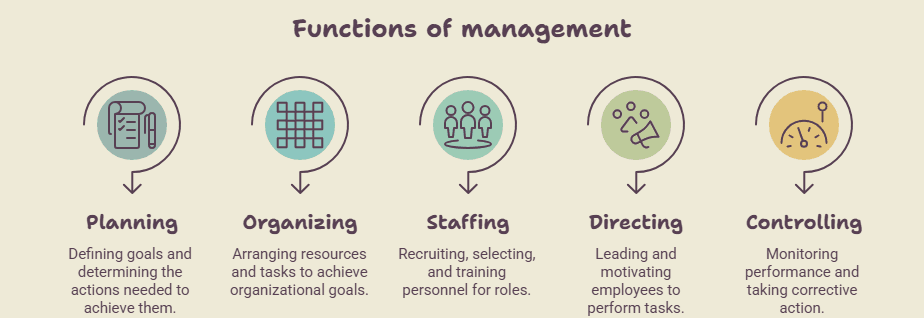
Planning
Planning includes making decisions about what the organization wants to do and how it will accomplish its goals.
- Objectives setting: This means setting measurable goals.
- Strategy formulation: Strategy is the method to be employed to reach those goals.
- Resource allocation: This is the planning of how people, finance, time, and material should be used.
- Risk planning: Risk planning entails identifying risks that might occur.
Organizing
This involves organizing people, resources, and actions in such a way as to make the completion of work efficient. Managers establish an organizational structure that ensures accountability for certain tasks.
- Division of work: Involves breaking down bigger actions into smaller tasks.
- Assignment of responsibility: Involves assigning tasks to people.
- Assignment of authority: Establishes reporting lines and accountability.
Staffing
Staffing is all about recruiting, selecting, developing, and retaining personnel who are needed to carry out organizational functions.
- Recruitment: This involves attracting appropriate candidates.
- Selection: This involves choosing appropriate candidates according to organizational needs.
- Training and Development: This involves building the capabilities of employees.
- Performance management: This involves evaluating the performance of employees and improving their weaknesses.
Directing
Directing means guiding, supervising, and motivating the employees to carry out their duties. Managers guide and support the employees while ensuring proper communication.
- Leadership: Guides the employees towards the organizational goals.
- Motivation: Motivates the employees to perform effectively.
- Communication: Communicates information, instructions, and feedback.
- Supervision: Supervises the performance of the employees and guides them if required.
Controlling
Controlling involves checking the performance of the organization against its plans and making necessary corrections if needed. It helps managers find out any gaps in the activities of the organization.
- Performance standards setting: Setting up the standards for performance.
- Performance measurement: Performance monitoring.
- Deviation identification: Identifying the deviations from planned performance.
- Corrective actions: Taking steps to correct the performance.
Dive Deeper: Best Online MBA Colleges in India for General Management
Conclusion
Management is essential for achieving organizational goals, improving productivity, and ensuring the effective use of resources. Its key functions, planning, organizing, staffing, directing, and controlling help managers coordinate people, processes, and resources while adapting to business changes.
For those looking to build management and leadership skills, an Online MBA can provide practical knowledge for a range of management careers. Talk to a Counsellor to explore suitable Online MBA programs and specializations.